Coercive Maintenance: How Beijing Wages Influence Operations Against the Republic of Korea
Paul Yoo, PhD | Cliff Bean | May 2026

BOTTOM LINE UP FRONT
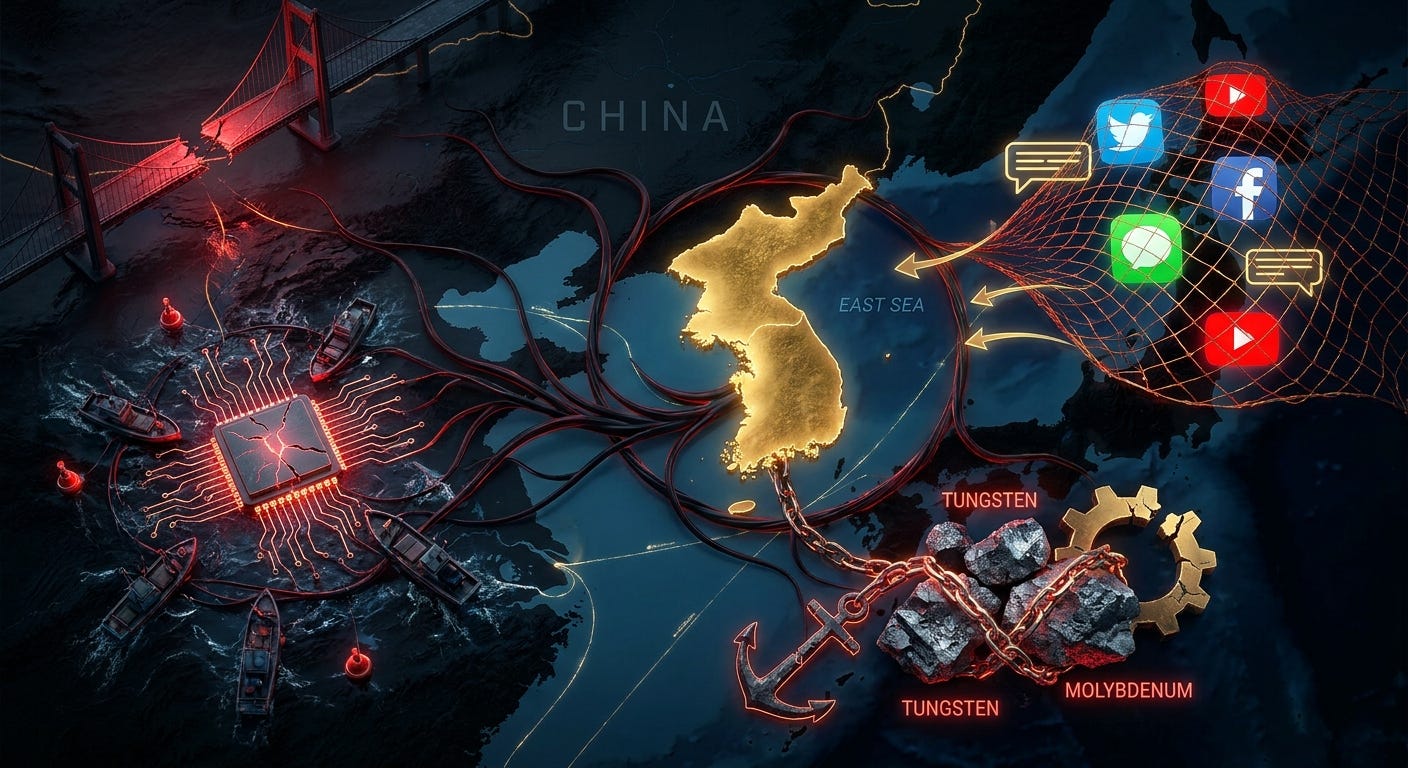
The People’s Republic of China is running a structurally present but operationally underperforming influence campaign against the Republic of Korea. Beijing has invested across the full spectrum of coercive instruments, including espionage, economic leverage, maritime gray zone operations, information environment penetration, and cultural coercion, yet the aggregate strategic return is modest and contested. Where PRC operations succeed, they do so through deniable espionage networks, incremental maritime encroachment, and informal cultural bans that cannot be legally challenged. Where they fail, they fail visibly: overt economic pressure and information operations consistently harden South Korean public resistance rather than generating alignment. The campaign is best characterized as structural coercion: Beijing need not win public opinion or recruit elites directly, only maintain the incentive environment that makes behavioral alignment and strategic asset extraction rational outcomes.
WHAT BEIJING IS DOING
Technology Espionage. PRC technology espionage against South Korea’s semiconductor and defense sectors is persistent and accelerating. In 2025 alone, the Korean National Police Agency documented 179 cases, a 45.5% year-over-year surge, with China accounting for 54.5% of confirmed overseas transfers.¹ High-profile indictments that year included former Samsung personnel leaking 10nm DRAM process technology to CXMT² and a former SK Hynix employee who illegally provided proprietary data to HiSilicon while seeking employment there.³ The pattern extends to military intelligence, where a ROK Army soldier was arrested for leaking Ulchi Freedom Shield exercise plans to the PLA Intelligence Bureau, recruited via RedNote and paid via Alipay.⁴
Maritime Gray Zone Operations. Beijing is applying incremental encroachment in the West Sea Provisional Measures Zone (PMZ), a strategy analysts have compared to PRC tactics in the South China Sea.⁵ Up to 16 unauthorized structures have been documented in the PMZ, including one integrated management platform, two aquaculture cages, and 13 buoys.⁵˒⁶ Incidents have escalated, with Chinese maritime police threatening the crew of the research vessel ONNURI in February 2025,⁷ and South Korean coast guard seizing two Chinese fishing vessels near Baengnyeong Island in May 2026, with one fatality.⁸ The structures have forced Seoul to expend summit-level diplomatic attention on their removal, with Lee raising the issue at both the 2025 APEC summit and the January 2026 Beijing summit before China agreed to relocate one platform, characterizing the move as a commercial decision.⁹˒¹⁰˒¹¹
Economic Leverage and Cultural Coercion. China weaponizes both trade and culture against South Korea. China’s February 2025 export controls on tungsten, molybdenum, and three other critical minerals exposed a sleeper threat in critical minerals: South Korea sources approximately 85% of its tungsten imports and over 90% of its molybdenum from China.¹² Simultaneously, Beijing has maintained an informal Hallyu ban since 2016, enforced through regulatory pressure and never formally acknowledged. Recent examples illustrate its persistence. BTS’s current world tour omits China entirely, and the January 2026 Lee-Xi summit produced a cultural exchange agreement limited to soccer and go, with Xi offering idioms rather than commitments.¹³˒⁹
Information Environment Penetration. PRC information operations in South Korea combine overt infrastructure with covert amplification. The National Intelligence Service documented 38 fake Korean-language news websites operated from Chinese servers, confirmed by Citizen Lab’s 2024 PAPERWALL report.¹⁴ Storm-1376 (Spamouflage/Dragonbridge, attributed to the PRC Ministry of Public Security) has deployed hundreds of Korean-language posts across Kakao Story, Tistory, and Velog.io, incorporating AI-generated content since September 2023 and amplifying domestic political figures to exploit existing divisions.¹⁵ Tencent, designated a “Chinese military company” by the United States in January 2025, holds a 10.11% stake in SLL중앙 (formerly JTBC Studios), embedding PRC-linked capital directly into South Korea’s media ecosystem, though Tencent holds no management role.¹⁶
Across espionage, gray zone operations, economic coercion, and information operations, Beijing’s approach follows a single logic: maintain the conditions under which South Korean behavioral alignment becomes rational, while keeping each individual instrument below the threshold that would compel a decisive response. However, South Korea is not without a response.
PUBLIC BACKLASH AND STRUCTURAL RESISTANCE
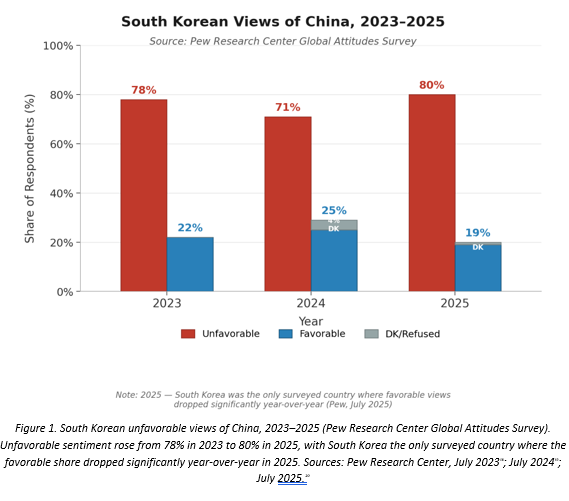
The origin event is the 2017 THAAD retaliation, in which Beijing’s economic coercion campaign produced the precise opposite of its intended effect, generating sustained public hostility and anti-China sentiment that shaped the political environment for subsequent South Korean governments.¹⁷ Beijing has not solved this constraint. South Korean public hostility toward China is consistent and worsening, with Pew Research Center recording 78% unfavorable sentiment in 2023,¹⁸ 71% in 2024,¹⁹ and 80% in 2025, with South Korea the only surveyed country where the favorable share dropped significantly year-over-year.²⁰ Every subsequent instance of overt PRC pressure has reproduced this dynamic at smaller scale.
South Korea is increasing structural resistance, as seen in recent legislative changes. For decades, PRC intelligence services exploited a legal anomaly in South Korea’s criminal code. Espionage statutes applied exclusively to North Korea, leaving Chinese espionage activities prosecutable only under lesser statutory offenses.²¹ The National Assembly closed this gap on February 26, 2026, passing a Criminal Code amendment expanding the espionage offense to any foreign state.²² The National Intelligence Service, which had long advocated for the reform, cited a 150% increase in foreign espionage between 2020 and 2024 and stated the law “establishes an institutional foundation to protect national security and national interests from espionage activities by foreign countries.”²³
RECOMMENDATIONS FOR US POLICY
1. Institutionalize West Sea gray zone monitoring. The US-ROK alliance has no dedicated bilateral mechanism for monitoring and responding to PRC gray zone activity in the West Sea PMZ. The United States should propose a standing US-ROK-Japan maritime domain awareness cell covering the Yellow Sea, modeled on South China Sea monitoring frameworks, with shared sensor data and coordinated diplomatic response protocols.
2. Expand the US-ROK Countering Disinformation MOU. The December 1, 2023 US-ROK Memorandum of Understanding on Countering Disinformation²⁴ should be expanded to include active counter-network operations against PRC-operated fake Korean-language news infrastructure, with Citizen Lab and allied signals intelligence partners integrated into the attribution pipeline.
3. Counter elite capture through transparency mechanisms. South Korean executive-branch behavior has at times reflected PRC-aligned preferences, including government efforts to restrict anti-China protests ahead of Xi Jinping’s 2025 APEC visit.²⁵˒²⁶ This pattern warrants monitoring given its divergence from South Korean public sentiment. The United States should prioritize engagement with the National Assembly, Korean Bar Association, and independent media as structural checks on executive-branch PRC alignment.
Dr. Dave Dickey is a Senior Science Advisor at Peraton with over 20 years of experience conducting geopolitical intelligence analysis and strategic communications research. Cliff Bean is the Senior Director for Cognitive Warfare at Peraton with over 30 years of understanding and operating in the information environment. The views expressed in this paper are those of the authors and do not represent the official positions of Peraton or any U.S. government agency.
ENDNOTES
¹ Korean National Police Agency (KNPA), National Office of Investigation. Annual Technology Leak Crackdown Results. Released January 19–20, 2026. (179 total cases, +45.5% YoY; 378 suspects; China accounted for 18 of 33 confirmed overseas transfer cases, 54.5%.) https://www.hani.co.kr/arti/society/society_general/1240435.html
² Seoul Central District Prosecutors’ Office. Indictment: Technology Leak to CXMT [Press release]. December 23, 2025. (10 former Samsung employees indicted for leaking 10nm DRAM process technology to CXMT; Samsung spent ₩1.6 trillion developing the technology.) See: Reuters (Heekyong Yang). “South Korea Charges 10 Over Alleged Chip Technology Leak to China’s CXMT.” December 26, 2025. https://finance.yahoo.com/news/south-korea-charges-10-over-082944853.html
³ Seoul Central District Prosecutors’ Office. Indictment: Technology Leak to HiSilicon [Press release]. May 7, 2025. (CMOS image sensors (CIS) and wafer-to-wafer bonding technologies; 11,000+ proprietary document images exfiltrated.) See: Digitimes. “Ex-SK Hynix Employee Charged in South Korea for Leaking Chip Tech to HiSilicon.” May 8, 2025. https://www.digitimes.com/news/a20250508PD224/sk-hynix-legal-packaging-hisilicon.html
⁴ Korea JoongAng Daily. “Korean Soldier Indicted for Leaking Secrets to China Was Raised in Beijing, Prosecutors Say.” May 27, 2025. https://koreajoongangdaily.joins.com/news/2025-05-27/national/socialAffairs/Korean-soldier-indicted-for-leaking-secrets-to-China-was-raised-in-Beijing-prosecutors-say/2316485
⁵ Christy Lee. “Analysts: China Normalizing Its Claims to Maritime Zone Shared with South Korea.” Voice of America, January 23, 2025. https://www.voanews.com/a/analysts-china-normalizing-its-claims-to-maritime-zone-shared-with-south-korea/7947215.html; see also: Sang Hun Seok. “The Yellow Sea: An Overlooked Geopolitical Hotspot.” RUSI, January 29, 2025. https://my.rusi.org/resource/the-yellow-sea-an-overlooked-geopolitical-hotspot.html
⁶ Victor Cha. “Creeping Sovereignty? China’s Maritime Structures in the Yellow Sea (West Sea).” CSIS, December 9, 2025. (13 buoys deployed in and around the PMZ since 2018; two aquaculture cages; one integrated management platform.) https://www.csis.org/analysis/creeping-sovereignty-chinas-maritime-structures-yellow-sea-west-sea
⁷ South Korean government / media reports. “Chinese Maritime Police Threaten ONNURI Research Vessel Crew.” February 2025. http://www.channelm.co.kr/news/articleView.html?idxno=372
⁸ Agence France-Presse (AFP). “South Korea Seizes Chinese Fishing Vessels Near Baengnyeong Island; One Fatality.” May 9, 2026. https://www.firstpost.com/world/south-korea-seizes-2-chinese-fishing-boats-on-suspicion-of-illegal-fishing-1-dead-14009282.html
⁹ Xinhua News Agency. Xi Jinping remarks to President Lee Jae-myung, Beijing State Visit. January 5–6, 2026. https://english.news.cn/20260105/3d74a43478b0436eb6824d2731cc8da9/c.html
¹⁰ Kim Eun-jung. “Lee, China’s Xi Agree on Efforts for Peace on Korean Peninsula.” Yonhap News Agency, November 1, 2025. https://www.kdnworld.com/news/articleView.html?idxno=872
¹¹ Hankyoreh. “Seoul Says China’s Relocation of Structure in Yellow Sea Will ‘Aid’ Bilateral Ties.” January 28, 2026. https://english.hani.co.kr/arti/english_edition/e_national/1242163.html
¹² Ministry of Trade, Industry and Energy (MOTIE), Republic of Korea. Emergency Critical Minerals Review. February 14, 2025. (Molybdenum >90% and tungsten approximately 85% dependency confirmed.) https://www.prnewswire.com/news-releases/korea-zinc-solidifies-critical-role-in-us-korea-economic-security-amid-chinese-export-controls-as-the-worlds-no1-indium-producer-302376921.html
¹³ Associated Press (Ken Moritsugu and Juwon Park). “China’s K-pop Worries: The Reasons Why a Ban on Korean Entertainment Has Lasted a Decade.” April 9, 2026. https://www.yahoo.com/news/articles/chinas-k-pop-worries-reasons-010748854.html
¹⁴ National Intelligence Service (NIS), Republic of Korea. Report on Fake Korean-Language News Websites. November 2023. (38 sites operated from Chinese servers.) Confirmed by: Citizen Lab. PAPERWALL. February 7, 2024. https://citizenlab.ca/2024/02/paperwall-chinese-websites-posing-as-local-news-outlets-with-pro-beijing-content/
¹⁵ Nathan Beauchamp-Mustafaga. “Implications of Chinese Influence Operations for South Korea and the US-ROK Alliance.” Stimson Center Korea Program, February 2026. https://www.stimson.org/2026/implications-of-chinese-influence-operations-for-south-korea/
¹⁶ Financial Supervisory Service (FSS), Republic of Korea. DART Electronic Disclosure System. Tencent investment in SLL중앙 (formerly JTBC Studios), December 2020. (100 billion KRW; approximately 10.11% shareholding.) On Tencent’s DoD designation: New York Times. “U.S. Adds Tencent and CATL to List of Chinese Military Companies.” January 6, 2025. https://www.nytimes.com/2025/01/06/business/us-chinese-military-companies-tencent-catl.html
¹⁷ Voice of America (Brian Padden). “Beijing’s Anti-THAAD Moves Sour China Views in South Korea.” March 2017. https://www.voanews.com/a/poll-shows-rising-anti-china-sentiment-in-south-korea/3775137.html
¹⁸ Pew Research Center. Global Attitudes Survey: Views of China. July 2023. (South Korea: 78% unfavorable, 22% favorable.) https://www.pewresearch.org/global/2023/07/27/how-people-in-24-countries-view-china/
¹⁹ Pew Research Center. Global Attitudes Survey: Views of China. July 9, 2024. (South Korea: 71% unfavorable, 25% favorable.) https://www.pewresearch.org/global/2024/07/09/views-of-china/
²⁰ Pew Research Center. Global Attitudes Survey: Views of China and Xi Jinping. July 15, 2025. (South Korea: 80% unfavorable, 19% favorable. Direct Pew text: “In South Korea, however, the share of adults with a favorable view of China decreased from 25% in 2024 to 19% in 2025. This is the only country surveyed where this share has dropped significantly since last year.”) https://www.pewresearch.org/global/2025/07/15/views-of-china-and-xi-jinping-2025/
²¹ Radio Free Asia. “South Korea’s Spy Law Loophole Lets China Off the Hook.” September 19, 2023. https://www.rfa.org/english/news/china/korea-chinese-spying-09192023035249.html
²² National Assembly of the Republic of Korea. Criminal Code Partial Amendment Bill. Passed February 26, 2026. (Promulgated March 12, 2026; entry into force September 2026.) https://www.straightnews.co.kr/news/articleView.html?idxno=296071
²³ National Intelligence Service (NIS), Republic of Korea. Statement on Criminal Code Partial Amendment. February 27, 2026. (NIS reported 150% increase in foreign espionage between 2020 and 2024.) https://www.freezinenews.com/news/articleView.html?idxno=24268
²⁴ US-South Korea Memorandum of Understanding on Countering Disinformation. Signed December 1, 2023, Seoul. https://www.voanews.com/a/us-deals-with-allies-signal-concerns-over-china-s-disinformation-campaign-/7389344.html
²⁵ South China Morning Post. “South Korea Tries to Curb Anti-China Protests Ahead of Xi Visit.” October 11, 2025. https://www.yahoo.com/news/articles/anti-china-protests-putting-south-093000788.html; New York Times. October 24, 2025. https://www.nytimes.com/2025/10/24/world/asia/south-korea-china-protests.html
²⁶ ACLED (Armed Conflict Location and Event Data Project). “South Korea Protest Event Data.” Accessed May 22, 2026. (28 anti-China protest events recorded August 30 – October 29, 2025; full-year 2025 total of 46 events.) https://acleddata.com